

In modern metal fabrication, precision is everything. Whether working with structural frames, machine components, or customized assemblies, weld quality directly affects strength, appearance, and safety. One often overlooked but critical factor behind consistent results is the Welding Table. A high-quality welding table provides a stable, flat, and reliable foundation that allows welders to position parts accurately and repeatably.
As a professional Welding Table Manufacturer with controlled production systems and bulk supply capability, industrial-grade welding tables are designed to support precise fabrication across different industries. From small workshops to large-scale production lines, the right welding table plays a key role in improving accuracy, reducing errors, and increasing productivity.
This article explains what a welding table is, why it matters for welding accuracy, its main advantages, common types, and how it supports efficient industrial production.
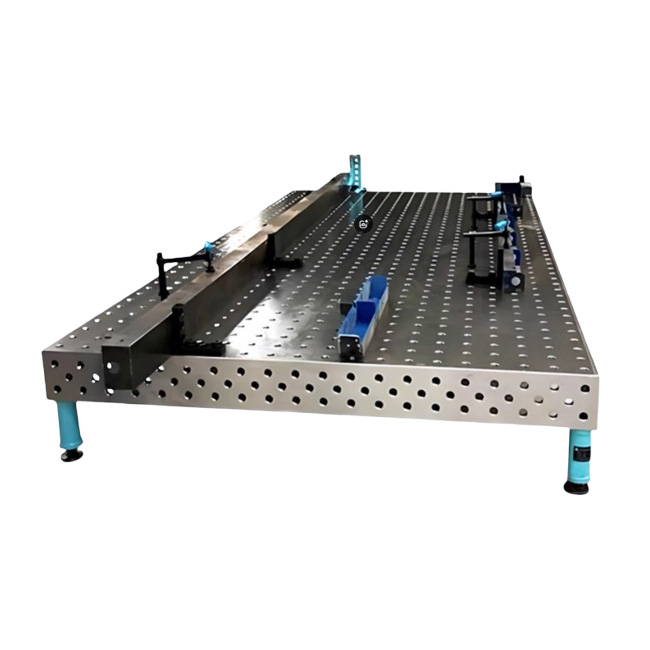
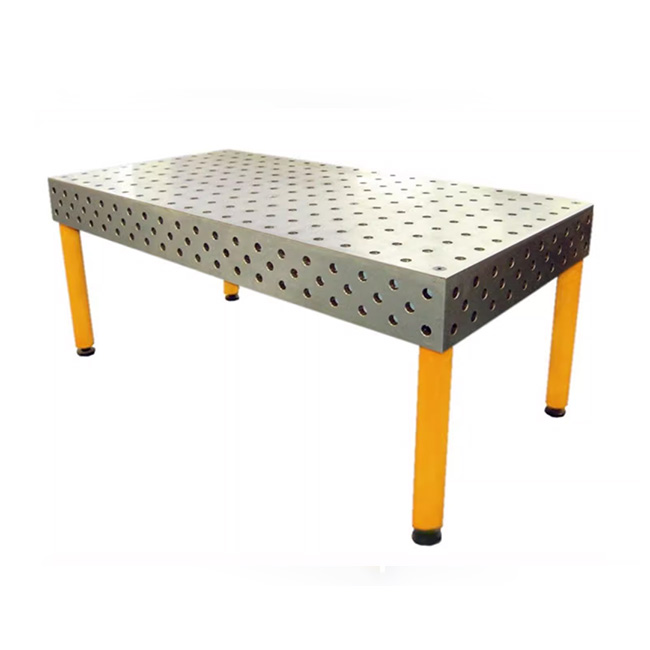 How a Welding Table Works in Practice
What Is a Welding Table?
A welding table is a specialized work surface used to hold, support, and align metal parts during welding, assembly, and fabrication. Unlike ordinary benches, welding tables are built from thick steel plates and precision-machined surfaces to remain flat under heat and load.
Typical features include:
·Flat and rigid tabletop
·Grid holes or slots for clamps and fixtures
·High load-bearing structure
·Heat and spatter resistance
·Modular positioning system
These features allow welders to secure workpieces accurately, ensuring that every joint is aligned before the arc is struck.
Why Welding Accuracy Depends on the Welding Table
1. Provides a Flat and Stable Reference Surface
Welding accuracy begins with alignment. If the work surface is uneven, parts will shift during welding, leading to distortion and dimensional errors.
A professional welding table is precision-machined to provide a consistent reference plane. This ensures that components remain square, parallel, and level throughout the welding process, which directly improves final assembly accuracy.
In production environments, this stability is essential for maintaining repeatable quality across batches.
2. Improves Positioning and Fixturing
Modern welding tables use hole patterns or T-slots to accept clamps, stops, and locating pins. These systems allow fast and precise positioning of parts.
With proper fixturing:
·Parts stay fixed during heat expansion
·Angles remain consistent
·Repeat setups become easier
·Human measurement errors are reduced
By improving positioning control, the welding table minimizes rework and ensures consistent weld geometry.
3. Reduces Welding Distortion
Heat input during welding causes metal to expand and contract. Without proper support, this leads to warping and misalignment.
A heavy-duty welding table absorbs and distributes heat while holding components firmly in place. This helps reduce deformation during cooling and preserves dimensional accuracy, especially for long frames or complex structures.
For high-precision fabrication, controlling distortion is just as important as welding technique itself.
4. Enhances Operator Efficiency and Consistency
When parts are easy to position and clamp, welders spend less time measuring and adjusting. The welding table becomes a productivity tool, not just a surface.
Benefits include:
·Faster setup times
·Fewer alignment mistakes
·Better ergonomics
·More consistent weld quality
In industrial production, this consistency leads to lower scrap rates and higher output per shift.
5. Supports Modular and Scalable Production
In manufacturing environments, repeatability matters. A professional welding table supports modular fixturing, allowing the same setup to be reused for multiple parts.
As a Welding Table Manufacturer with stable production and bulk supply capability, high-precision tables help factories standardize workflows and scale fabrication efficiently.
This is especially valuable for mass production of frames, brackets, machinery bases, and structural assemblies.
Types of Welding Tables Used in Industry
Flat Plate Welding Table
A solid steel plate surface used for general welding. It offers strong load capacity but limited modular flexibility.
Modular Welding Table
Features a grid system of holes for clamps and fixtures. This type is widely used for precision fabrication and batch production.
Adjustable Welding Table
Includes height or angle adjustment for ergonomic operation and special positioning requirements.
Heavy-Duty Welding Table
Designed for large components and high loads, often used in shipbuilding, machinery manufacturing, and steel structure production.
Each type improves accuracy differently depending on application and production scale.
How a Welding Table Improves Industrial Production
From a production perspective, the welding table is more than a tool—it is a foundation for quality control. It helps manufacturers achieve:
·Higher dimensional accuracy
·Reduced rework and scrap
·Stable process control
·Faster assembly cycles
·Safer working environments
A reliable Welding Table Manufacturer with advanced production systems ensures that every table meets flatness, strength, and durability requirements for long-term industrial use.
In automated and semi-automated lines, welding tables also integrate with jigs, robots, and fixtures, further improving repeatability and output capacity.
Key Factors When Choosing a Welding Table
To maximize welding accuracy, consider:
·Table flatness tolerance
·Load capacity
·Hole pattern compatibility
·Surface hardness and coating
·Heat resistance
·Table size and working height
Selecting the right welding table ensures it supports both current and future fabrication needs.
Applications of Welding Tables
Welding tables are widely used in:
·Machinery manufacturing
·Automotive frames
·Steel structure fabrication
·Equipment assembly
·Aerospace components
·Custom metal workshops
Wherever precision welding is required, the welding table becomes a central part of the process.
Future Trends in Welding Table Design
With the development of intelligent manufacturing, welding tables are evolving toward:
·Higher flatness accuracy
·Lighter but stronger materials
·Integrated clamping systems
·Compatibility with robotic welding
·Modular and reconfigurable layouts
These trends allow welding tables to better support modern production environments and high-precision demands.
Conclusion: Welding Table as the Foundation of Accuracy
In welding operations, a Welding Table is not just a platform — it is the foundation of welding accuracy and production efficiency. From providing a flat reference surface to supporting fixturing, reducing distortion, and enabling repeatable setups, the welding table directly impacts weld quality and productivity.
Working with a trusted Welding Table Manufacturer with strong production capability and reliable bulk supply ensures consistent quality and long-term performance. Whether for custom fabrication or large-scale industrial production, the right welding table helps turn skilled welding into precise, repeatable, and profitable results.
References
GB/T 7714:Suryanto A E, Lumbantobing M A, Murwantini S, et al. Design of a Welding Table with Electromagnetic Magnet Application to Enhance Welding Stability and Precision[J]. G-Tech: Jurnal Teknologi Terapan, 2025, 9(1): 29-39.
MLA:Suryanto, Ahmad Eko, et al. "Design of a Welding Table with Electromagnetic Magnet Application to Enhance Welding Stability and Precision." G-Tech: Jurnal Teknologi Terapan 9.1 (2025): 29-39.
APA:Suryanto, A. E., Lumbantobing, M. A., Murwantini, S., Samudra, A., & Supriyadi, S. (2025). Design of a Welding Table with Electromagnetic Magnet Application to Enhance Welding Stability and Precision. G-Tech: Jurnal Teknologi Terapan, 9(1), 29-39.