

A well-engineered welding table serves as the foundational work surface for fabrication shops, manufacturing facilities, and maintenance operations worldwide. Far from being a simple flat surface, a quality welding table incorporates structural design, material selection, and functional features that directly impact welding precision, operator efficiency, and long-term durability. Understanding these structural elements enables procurement teams and shop managers to select tables that deliver maximum value across years of intensive daily use.
This guide examines the core structural components of industrial welding table designs, from tabletop construction and support frameworks to fixturing systems and material compatibility considerations. The information presented reflects field experience from fabrication environments ranging from small job shops to high-volume manufacturing operations.
Tabletop Construction: The Core of Welding Table Performance
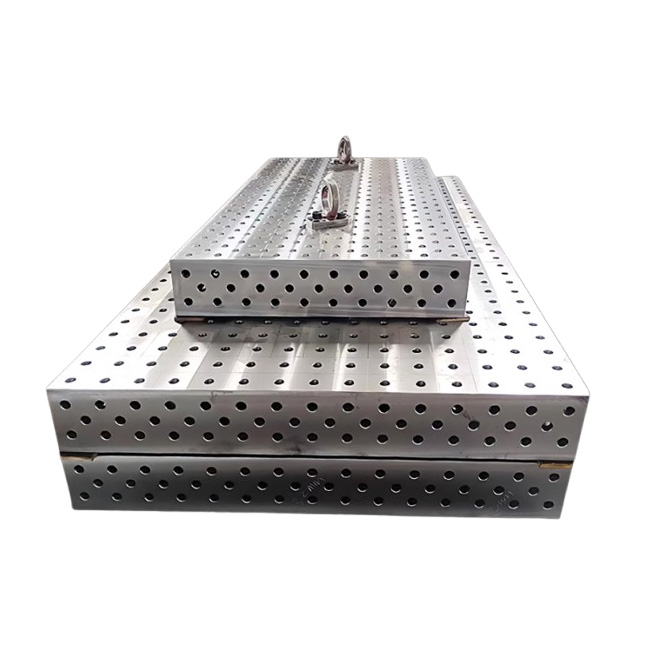
The tabletop is the primary working surface and arguably the most critical structural component of any welding table. Industrial-grade tabletops typically use steel plates ranging from 0.5 inches to over 2 inches in thickness, selected based on the expected welding current, workpiece weight, and precision requirements of the application.
Surface flatness directly affects welding accuracy, particularly for precision fixture welding and multi-component assemblies. Quality industrial welding table surfaces maintain flatness within 0.005 inches per foot of tabletop dimension. Achieving and maintaining this flatness requires substantial material thickness — thin surfaces warp under welding heat cycles and weight loads, progressively degrading precision over time.
Cast iron tabletops offer superior vibration damping and natural flatness compared to steel plate alternatives, making them preferred for precision applications. Cast iron's graphite microstructure absorbs vibration energy that would otherwise transmit through the table structure, reducing movement during critical welding operations. However, cast iron is brittle and susceptible to damage from dropped tools or heavy impact loading.
Structural Support Framework: Stability Under Load
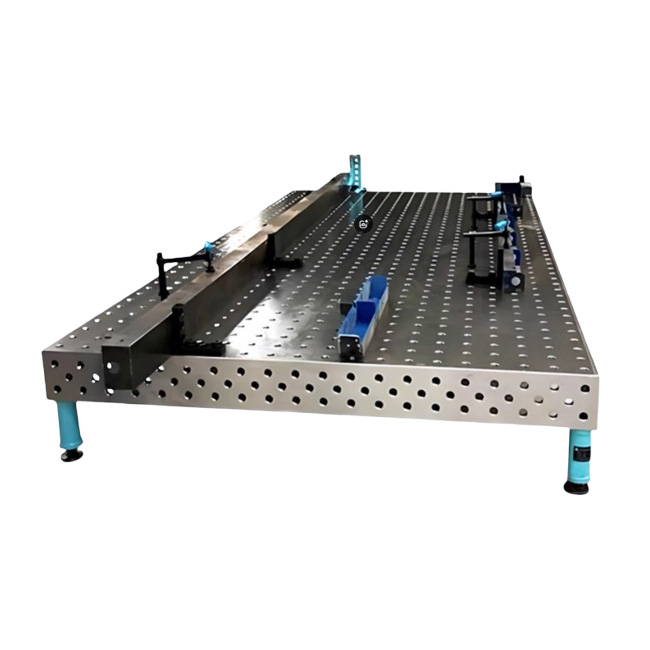
The support framework beneath the tabletop determines the welding table's load-bearing capacity and dimensional stability. Heavy-duty industrial designs employ box-section steel legs with cross-bracing that prevents lateral deflection under eccentric loading. The leg structure must support not only the tabletop weight but also the combined weight of workpieces, fixtures, clamping forces, and the dynamic loads imposed during welding operations.
Frame rigidity is particularly important for tables used in multi-pass welding, where workpieces remain clamped for extended periods. Frame deflection under sustained loading can introduce distortion into the workpiece, creating dimensional errors that only become apparent after welding completion and clamp release.
Adjustable leveling feet are essential for achieving precise horizontal positioning on workshop floors that are rarely perfectly flat. Industrial welding table designs incorporate heavy-duty leveling pads with sufficient adjustment range to compensate for floor variations of 1 inch or more. Locking mechanisms prevent drift during operations involving hammering, grinding, or other vibration-generating activities.
Fixturing Systems and Modular Capabilities
Modern industrial welding table designs increasingly incorporate modular fixturing systems that enable rapid setup and clamping of diverse workpiece geometries. The most widely adopted systems use a precision grid of threaded holes or DIN-rail slots machined into the tabletop surface, accepting standardized clamps, stops, and fixtures that position workpieces accurately without custom tooling.
Threaded hole systems — typically 16mm or 5/8-inch threads on 50mm or 2-inch spacing — provide the most versatile fixturing platform. The dense hole pattern allows clamping from virtually any angle and position, supporting complex assemblies that would require specialized fixtures on conventional flat tables. This flexibility reduces setup time by 40-60% compared to traditional clamping approaches according to fabrication shop productivity studies.
Standalone tooling blocks and angle plates extend the fixturing capabilities beyond the tabletop surface. These accessories bolt into the table's mounting system and provide additional reference surfaces for perpendicular, angled, or elevated clamping configurations.
Material Selection for Durability and Performance
Material selection for welding table construction balances structural performance, surface durability, electrical conductivity requirements, and cost considerations. Carbon steel remains the dominant material for structural components due to its excellent strength-to-weight ratio, weldability, and economic value. Mild steel plate (ASTM A36) is the standard tabletop material for general fabrication applications.
For applications involving stainless steel welding, a dedicated welding table with a stainless steel or copper alloy surface prevents cross-contamination between carbon steel and stainless workpieces. Even trace carbon steel particles embedded in a table surface can cause intergranular corrosion in sensitive stainless welds, making material compatibility a critical selection factor.
Aluminum tabletops serve lightweight fabrication applications and provide a non-sparking surface for environments where spark generation creates safety hazards. However, aluminum's lower melting point and higher thermal expansion coefficient compared to steel limit its suitability for heavy-duty or high-amperage welding applications.
Electrical Grounding and Safety Considerations
Proper electrical grounding of the welding table is a fundamental safety requirement. The table serves as the work return conductor (also called the work lead or ground clamp connection) in most welding circuits. A table with poor electrical conductivity or inadequate grounding connections creates voltage drops that compromise arc stability and increase the risk of stray arcing to nearby equipment.
Design features that support effective grounding include dedicated ground clamp mounting points with clean metal-to-metal contact, low-resistance bolted connections between tabletop and frame, and copper grounding braids linking all table sections in multi-section installations. Tables with painted or coated surfaces require grinding or machining of ground contact points to ensure reliable electrical continuity.
Safety standards including OSHA 29 CFR 1910.254 and AWS D1.1 address welding table grounding requirements in workplace safety contexts. Compliance with these standards protects operators from electric shock hazards and ensures consistent welding performance.
Load Rating and Working Capacity
Every welding table carries a rated working load capacity that defines the maximum static and dynamic loads the table can support without permanent deformation. Understanding these ratings — and selecting tables with appropriate capacity margins — prevents structural damage and maintains surface flatness over the table's service life.
Dynamic load capacity, which accounts for impact loads from workpiece placement and clamping forces, typically ranges from 50% to 70% of the static load rating. Tables rated for 2,000 pounds static capacity typically handle 1,000-1,400 pounds of dynamic loading in normal fabrication operations. Operating near or above the dynamic load rating accelerates frame fatigue and surface distortion.
Heavy industrial applications — such as structural steel fabrication, shipbuilding components, and heavy equipment manufacturing — demand tables with load ratings exceeding 5,000 pounds. These applications often employ reinforced plate tops with integral ribbing and heavy-gauge structural sections to achieve the necessary strength and rigidity.
Frequently Asked Questions
What thickness should a welding table top be?
For general fabrication work, a minimum tabletop thickness of 0.5 inches (12mm) provides adequate rigidity for most welding operations. Heavy fabrication involving large structural components benefits from 1-inch to 2-inch thick tops that resist deflection under heavy workpiece loads. Precision fixture welding requires the thickest practical surface to maintain flatness through repeated heat cycles and clamping forces.
Do I need a dedicated stainless steel welding table for stainless work?
Not always, but it is strongly recommended for any shop regularly welding stainless steel components. Carbon steel contamination embedded in a carbon steel table surface can transfer iron particles to stainless workpieces, causing rust contamination and potentially compromising corrosion resistance. Many shops maintain separate carbon steel and stainless steel tables, or use removable stainless steel overlay plates on their primary tables.
How important is welding table flatness?
Flatness importance depends directly on the precision requirements of your welding applications. General structural fabrication tolerates surface flatness within 0.030 inches per foot. Precision fixture welding and tight-tolerance assemblies may require flatness within 0.005 inches per foot. Thicker tabletops maintain flatness longer because the thermal cycles of welding produce less distortion in heavier sections.
Can a welding table be used for purposes other than welding?
Yes. Quality welding tables serve effectively as general-purpose fabrication and assembly surfaces. The fixturing systems, load capacity, and structural rigidity that benefit welding operations equally support metal cutting, grinding, drilling, and mechanical assembly tasks. The threaded hole pattern common in modern welding tables provides versatile clamping capability for virtually any fabrication activity.
What maintenance does a welding table require?
Routine maintenance includes cleaning the surface to remove welding spatter and debris, checking leveling feet for position stability, inspecting ground connections for tightness and corrosion, and lubricating threaded hole inserts to prevent seizure. Periodic flatness verification using a straightedge and feeler gauges identifies developing warpage that may require surface re-machining to restore precision.
Conclusion
The structural design of a welding table directly determines its performance, longevity, and value in industrial fabrication environments. Key structural elements — tabletop thickness and material, support framework rigidity, fixturing system versatility, electrical grounding provisions, and load capacity ratings — must be evaluated together to select a table that matches the specific demands of your welding operations. Investing in a properly specified welding table from the outset avoids the progressive performance degradation and costly replacements that result from underspecified equipment. Quality welding tables serve as the reliable, precision work platform that supports consistent fabrication quality across years of demanding daily use.
References
AWS D1.1/D1.1M — Structural Welding Code: Steel
OSHA 29 CFR 1910.254 — Arc Welding and Cutting Safety Requirements
Jeffus, L. (2012). Welding Principles and Applications, 7th Edition. Cengage Learning.
ASM Handbook Volume 6A — Welding Fundamentals and Processes
ISO 9612:2009 — Acoustics: Determination of Occupational Noise Exposure