

Mining equipment operates at the extreme end of industrial coupling duty. A crusher jaw that chews rock generates torque spikes of 200 to 300 percent above running torque every time it jams and re-engages. A long overland conveyor runs through dust that would destroy any seal not designed for it, in an environment where a coupling failure costs not just a repair but a production shift on an operation where every hour of output has a direct dollar value. An apron feeder starts and stops under full load dozens of times per shift, cycling the coupling through its full torque range with a frequency that no other industry approaches. The industrial grid coupling that survives this environment is not the same coupling that handles a clean-room fan — and knowing the difference is what keeps the production line running.
The Shock Loading Profile in Mining Drives
Jaw crushers, cone crushers, and impact crushers generate the most severe coupling duty in mining. The compression and fracture of rock produces intermittent resistance spikes that pass through the drive train as torque impulses. The motor nameplate gives running torque; the jam-start torque — the torque required to re-engage the crusher after a stall — is what determines whether the coupling survives the event without damage.
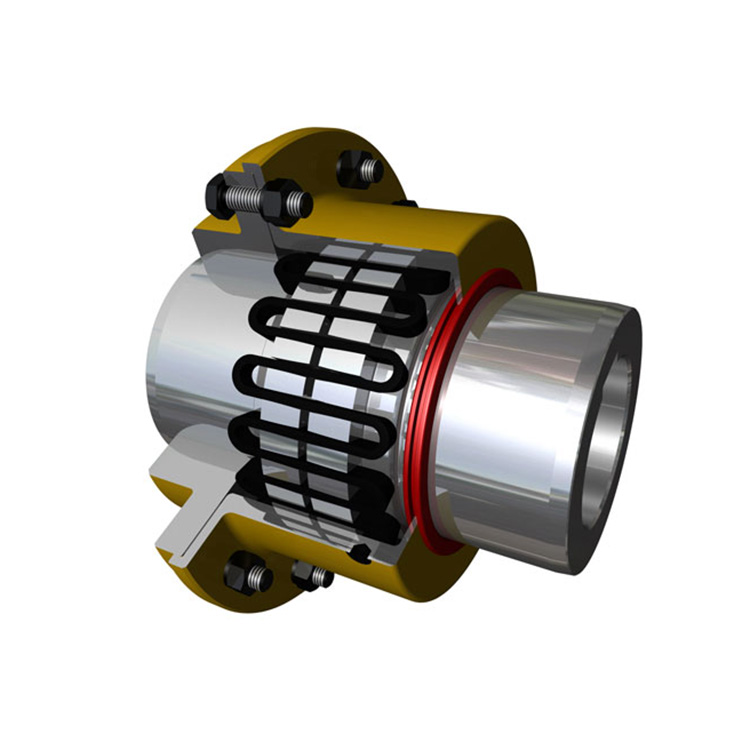
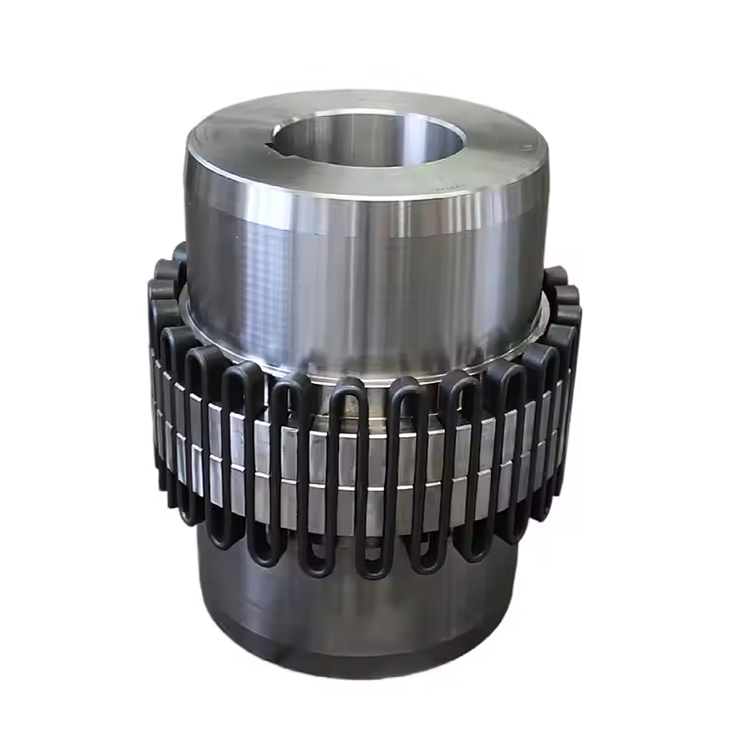
The industrial grid coupling is designed for exactly this profile. Its steel grid element deflects under the jam-start torque impulse, absorbing the peak and releasing it gradually into the driven machine. The grid's peak torque rating — typically 2.0 to 2.5 times the continuous torque rating for the T20 and equivalent heavy-duty series — is the parameter that defines whether the coupling handles the crusher's actual jam-start event or bottoms out and transmits the full impulse to the gearbox. A coupling selected only on running torque, without checking the peak torque against the crusher's jam-start requirement, is undersized from the first start.
Contamination: Dust, Moisture, and the Seal as the First Line of Defense
Open-pit and underground mining operations generate dust levels that no standard nitrile seal can manage indefinitely. Silica dust, ore fines, and the abrasive particles common in crushing and screening environments penetrate seal lips, contaminate the lubrication, and accelerate grid wear at the slot contacts. Once contamination enters the coupling housing, the grid element begins wearing against particulate that acts as an abrasive between the steel grid and the housing slot surfaces.
The seal specification for a grid coupling in mining service must account for the contamination environment specifically. Standard nitrile seals serve adequately in moderate dust; severe dust environments — crushing circuits, conveyor transfer points, mill feed areas — may require enhanced seal designs, more frequent lubrication intervals, or periodic coupling inspection and cleaning as part of the planned maintenance schedule. The alternative — allowing contamination to accumulate until the grid fails — is an unplanned outage in an environment where the next maintenance window may not come for days.
High Torque and the Size Implications for Mining Equipment
Large mining equipment — primary crushers, semiautogenous grinding mills, apron feeders — transmits torque levels that push coupling sizes large enough that the physical dimensions of the coupling become an installation constraint. A 600-kilowatt conveyor drive may require a coupling sized for 6,000 to 8,000 Newton-meters of torque, with a hub diameter and length that affect the machine design and the maintenance access space.
The industrial grid coupling for mining equipment must be selected with the actual maximum torque — including the torque amplification from the driven machine's load characteristics — not the motor nameplate alone. For heavy mining equipment, the service factor is typically 2.0 to 2.5, and the selection torque is the motor torque multiplied by this factor. The size that results from this calculation must then be checked for bore fit, speed rating, and the physical space available for hub length and outside diameter in the machine's drive train layout.
Conveyor Drives: Continuous Duty and the Maintenance Constraint
Overland and plant conveyors in mining run continuously for shifts at a time, and the maintenance window for a conveyor coupling is typically the shift change — two to four hours at most. This constraint shapes the industrial grid coupling selection in a specific way: the coupling's serviceability matters as much as its performance. A coupling that requires a full day to replace, with hub puller and heating equipment and a crane, takes the conveyor out of service for a full shift regardless of the speed of the maintenance crew.
The grid coupling's design serves this constraint well. The grid element is a replaceable component that can be changed in the field without moving the hubs — the coupling housing is split or the sleeve is removed, the worn grid is extracted, and a new grid is installed with fresh grease. The total job, for a crew trained on the procedure, is two to four hours on a medium-sized conveyor coupling. This is not true of gear couplings or rigid couplings, which require hub removal and reassembly for element replacement, extending the maintenance window significantly.
Remote Locations and the Spare Parts Equation
Mining operations in remote locations — underground mines, remote open-pit sites, concentrators in isolated regions — face a spare parts logistics challenge that urban industrial plants do not. A coupling that fails at a remote site cannot be replaced with a two-hour delivery from the nearest distributor. The spare grid element and seal kit for the site-critical industrial grid coupling sizes must be stocked on site, and the stock levels must reflect the expected failure rate given the operating conditions and the lead time to resupply.
The spare parts calculation for remote mining sites is a function of the number of coupling sizes in service, the failure rate per size (derived from operating hours and duty severity), and the resupply lead time including customs and transport. A site running twelve identical conveyors with the same grid coupling size should stock at minimum one spare grid element per critical machine, plus one complete spare coupling for the most critical drive, with resupply ordered when the stock drops to two units.
Thermal Conditions in Mining: Heat from Processing and Cold from Environment
Mining equipment operates in thermal environments that span a wider range than most industrial settings. Grinding mill drives and hot-screen applications generate elevated coupling housing temperatures, reducing grease viscosity and increasing the rate of seal degradation. Underground mines and cold-climate surface operations can expose couplings to temperatures below minus 20 degrees Celsius, at which standard petroleum-based greases thicken significantly and the coupling's cold-start torque requirements increase.
For hot mining applications, the industrial grid coupling should be selected with a thermal margin — either the next size above the torque selection or an explicit thermal derating applied to the catalog torque rating. For cold environments, the grease specification should be verified against the minimum operating temperature, and the coupling's cold-start torque requirement should be calculated to confirm the motor can accelerate the driven load at the reduced grease viscosity. Both conditions are addressable at the selection stage with information the coupling manufacturer can provide.
Planned Maintenance Programs for Mining Grid Couplings
The maintenance strategy for industrial grid coupling in mining service is condition-based, not purely calendar-based. The grid element wears progressively, and the wear rate is a function of the duty severity — a grid on a heavy-crusher coupling in a high-shock application wears faster than one on a uniform-load conveyor. A condition-based program uses the drained grease inspection and vibration monitoring to set the actual replacement interval rather than relying on a generic calendar interval that may be too conservative for severe applications or too aggressive for lighter ones.
Gear contamination in the drained grease is the primary condition indicator for a grid coupling in mining service. When the drained grease from a scheduled inspection contains visible metallic particles — not just the fine steel shimmer of normal grid running-in, but coarse wear particles — the grid cross-section has reduced measurably and the replacement interval should be advanced. Vibration trending at motor speed frequency also provides an early warning of coupling degradation before the grid reaches a critical cross-section, allowing the replacement to be scheduled for the next planned outage rather than the next emergency.
Frequently Asked Questions
What service factor should I use for a mining crusher coupling?
For heavy shock applications like jaw, cone, and impact crushers, a service factor of 2.0 to 2.5 is standard for grid coupling selection. The coupling must be checked against the jam-start torque, not just the running torque, and the peak torque rating of the selected coupling must exceed the crusher's jam-start requirement with margin.
How does dust affect industrial grid coupling life in mining?
Dust penetrates seal lips and contaminates the grease, introducing abrasive particles between the grid and the housing slot surfaces. This accelerates wear and reduces the effective grid cross-section faster than the design life assumes. In severe dust environments, shorter lubrication intervals and periodic coupling inspection are required to catch contamination-driven wear before it reaches critical levels.
Why is the grid coupling's serviceability important for mining conveyors?
Conveyor coupling failures in mining are constrained by short maintenance windows — typically a shift change of two to four hours. The grid coupling's design allows grid element replacement without hub removal, bringing the total job within the maintenance window for a trained crew. Gear couplings and rigid couplings require more extensive disassembly, extending the downtime beyond the available window.
How do I set the lubrication interval for a grid coupling in a remote mining location?
Start with the manufacturer's standard interval for the application conditions, then adjust based on drained grease condition from scheduled inspections. In high-contamination environments, shorten the interval until the inspection results show the grease is still within acceptable condition. Stock sufficient spare grease and seals on site to maintain the interval without dependency on rapid resupply.
Conclusion
The industrial grid coupling for mining equipment earns its place through the combination of shock absorption for crusher duty, contamination resistance through seal and lubrication design, high torque capacity matched to the drive sizes, and field serviceability that fits the maintenance windows that mining operations can actually afford. Selecting the coupling for the actual duty — jam-start torque as well as running torque, dust severity as well as nominal contamination level, thermal environment as well as catalog speed rating — is what separates a coupling that survives the mine from one that becomes the unplanned outage that the production schedule cannot absorb. A planned maintenance program built on grease inspection and vibration monitoring converts the grid coupling's progressive failure mode from a liability into an asset: the coupling tells you when it needs attention before the attention becomes an emergency.
References
AGMA 9002-B04 — Flexible Couplings: Design Considerations and Selection
ISO 14691:2008 — Flexible Couplings: Design, Selection and Application
Bloch, H.P. & Geitner, F.K. (2011). Machinery Failure Analysis and Troubleshooting, 4th Edition. Butterworth-Heinemann.
Mancuso, J.R. (1999). Couplings and Joints: Design, Selection, and Application, 2nd Edition. Marcel Dekker.
NI 43-101 — Standards of Disclosure for Mineral Projects (CIM Definition Standards)