

Heavy machinery operates under extreme conditions, including high torque, vibration, misalignment, and frequent load changes. To maintain system stability and efficiency, reliable power transmission components are essential. One of the most widely used solutions in such environments is the Industrial Grid Coupling.
An Industrial Grid Coupling connects two rotating shafts while transmitting torque smoothly and protecting equipment from shock and vibration. Unlike rigid couplings, grid couplings use a flexible spring element to distribute load and compensate for alignment errors. With advanced production processes and factory-level manufacturing, modern grid couplings are engineered to perform consistently in mining, cement, metallurgy, and bulk material handling industries.
A professional Industrial Grid Coupling Manufacturer focuses on precision machining and controlled production to ensure stable performance across large-scale industrial projects.
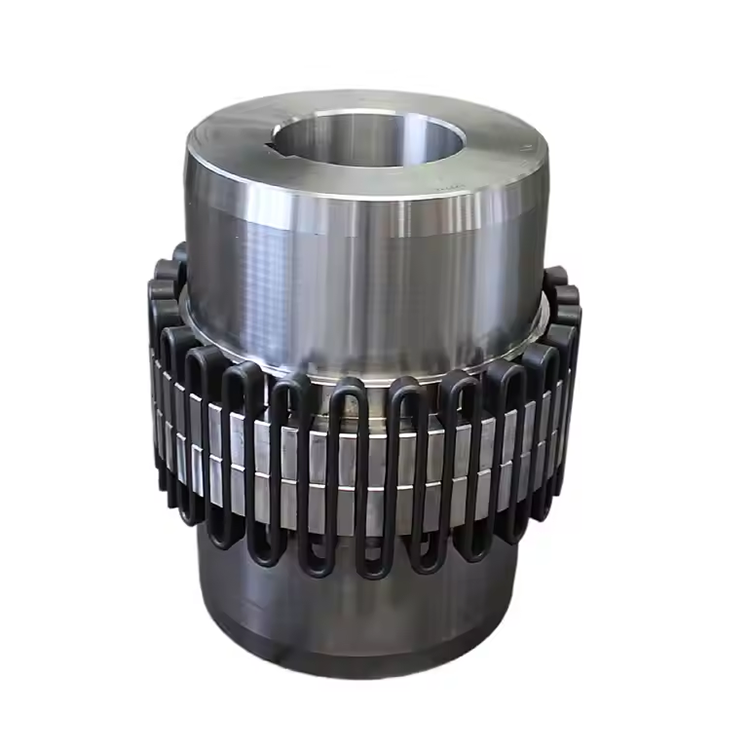

What Is an Industrial Grid Coupling?
An Industrial Grid Coupling, also known as a Spring Grid Coupling, uses a serpentine steel spring grid positioned between two precision-machined hubs. These hubs contain grooves that hold the grid element and transfer torque between shafts.
When the driving shaft rotates, torque passes through the hubs into the spring grid. The grid flexes slightly, allowing the coupling to absorb shock loads, damp vibration, and accommodate angular, axial, and radial misalignment.
Factory production emphasizes material selection, heat treatment, and accurate groove machining to ensure high torque capacity and long fatigue life. This makes industrial grid coupling production suitable for heavy machinery operating under continuous stress.
Why Heavy Machinery Needs Grid Coupling
Heavy machinery often experiences:
·Sudden startup and shutdown loads
·Continuous vibration
·Shaft misalignment due to thermal expansion
·High torque transmission demands
Industrial Grid Coupling technology addresses these challenges by providing elastic torque transmission. The spring grid spreads load across multiple contact points, reducing localized stress. This protects bearings, gearboxes, and motor shafts from premature failure.
In factory production environments, grid couplings are tested under load to ensure performance stability. Manufacturers supplying bulk production projects rely on consistent quality control to meet industrial reliability requirements.
Key Applications of Industrial Grid Coupling
1. Conveyor Systems
Conveyors in mining, ports, and cement plants require stable power transmission over long distances. Industrial Grid Coupling absorbs shock during belt startup and load fluctuation, improving system reliability and reducing maintenance downtime.
Factory-produced T20 Grid Coupling models are commonly selected for conveyor drives due to their balance of torque capacity and flexibility.
2. Mining Equipment
Mining machinery operates under heavy impact and dust conditions. Crushers, feeders, and screening machines benefit from industrial grid coupling’s shock absorption and misalignment tolerance.
With professional production control, grid couplings for mining applications maintain consistent performance even in harsh environments. Manufacturer support also enables bulk supply for large mining projects.
3. Cement and Metallurgy Plants
Rotary kilns, mills, and fans in cement and metallurgical production lines require continuous operation. Industrial Grid Coupling reduces vibration transmission and compensates for shaft movement caused by temperature changes.
Factory manufacturing ensures dimensional accuracy, which is critical for long-term stability in high-temperature industrial processes.
4. Pump and Fan Systems
Large pumps and fans often experience fluctuating loads and alignment changes. Spring Grid Coupling technology helps stabilize torque flow while protecting motor and bearing systems.
Production-level inspection and assembly ensure each industrial grid coupling unit delivers reliable performance under high-speed rotation.
5. Bulk Material Handling Machinery
Stackers, reclaimers, and loaders depend on smooth torque transfer. Industrial Grid Coupling reduces impact during material loading and unloading, improving operational safety and equipment life.
Manufacturer-level production allows customization based on shaft size, torque demand, and environmental exposure.
Performance Advantages in Industrial Use
Using an Industrial Grid Coupling provides multiple performance benefits for heavy machinery:
·High Torque Transmission – Suitable for continuous production systems.
·Shock Absorption – Protects equipment during sudden load changes.
·Misalignment Compensation – Handles angular, axial, and radial offsets.
·Vibration Reduction – Improves operating stability and noise control.
·Extended Service Life – Factory-quality materials and production processes enhance durability.
Compared with rigid couplings, industrial grid coupling solutions offer better system protection and reduced lifecycle cost.
Manufacturing and Production Quality
The performance of Industrial Grid Coupling depends strongly on manufacturing quality. Professional factory production focuses on:
·Precision CNC machining of hubs
·Accurate spring grid forming
·Heat treatment for fatigue resistance
·Assembly verification
·Load and balance testing
A reliable Industrial Grid Coupling Manufacturer and Factory Production system ensures consistency across bulk orders. Large-scale production capacity also supports customization for specific industrial applications.
Quality-controlled production reduces installation issues and ensures long-term stability in heavy machinery environments.
Selecting the Right Industrial Grid Coupling
When choosing an Industrial Grid Coupling for heavy machinery, consider:
·Required torque capacity
·Shaft diameter and speed
·Operating environment
·Misalignment tolerance
·Maintenance accessibility
Working with a manufacturer that offers technical support and stable factory production helps ensure correct selection and efficient bulk supply.
Conclusion: Industrial Grid Coupling in Heavy Machinery
Industrial Grid Coupling plays a critical role in heavy machinery by delivering torque while protecting equipment from shock, vibration, and misalignment. Its spring-based design provides a balance between strength and flexibility, making it ideal for demanding industrial environments.
Backed by professional Manufacturer experience and Factory Production capability, industrial grid coupling solutions support large-scale projects with reliable performance and scalable supply. From conveyors and mining equipment to pumps and cement plants, Industrial Grid Coupling remains a key component in modern heavy machinery power transmission systems.
With controlled production processes and factory-level quality management, Industrial Grid Coupling continues to provide dependable solutions for global heavy machinery applications.
References
GB/T 7714:Rechreche E, Bruyère J, Le Guennec Q, et al. Experimental and numerical analyses of grid couplings in quasi-static and dynamic conditions[J]. Mechanism and Machine Theory, 2024, 203: 105807.
MLA:Rechreche, E., et al. "Experimental and numerical analyses of grid couplings in quasi-static and dynamic conditions." Mechanism and Machine Theory 203 (2024): 105807.
APA:Rechreche, E., Bruyère, J., Le Guennec, Q., & Velex, P. (2024). Experimental and numerical analyses of grid couplings in quasi-static and dynamic conditions. Mechanism and Machine Theory, 203, 105807.