

A spring grid coupling is five or six distinct material systems working together in a sealed housing: the grid element that takes the cyclic stress, the two hubs that transmit torque from the shafts, the sleeve or cover that contains the grid and the grease, the seals that keep contamination out and lubricant in, and the lubricant itself. Each material choice is an engineering decision with direct consequences for the coupling's fatigue life, corrosion resistance, temperature range, and maintenance burden. For a performance-focused perspective, see how T20 grid coupling performance under heavy load is shaped by the material decisions described in this article. Understanding what is inside a spring grid coupling and why the materials are chosen the way they are is the basis for specifying correctly and recognizing when a lower-cost alternative is saving money in the wrong place.
The Grid Element: Where the Steel Decision Matters Most
The grid is a precision-cut steel spring that flexes with every shaft revolution. Its material requirements are specific: adequate yield strength to survive the deflected state without permanent set, sufficient fatigue strength to carry millions of stress cycles without cracking, and toughness to resist brittle fracture under the shock events the coupling is designed to absorb. These requirements point to a medium-carbon or low-alloy steel in the range of 0.35% to 0.55% carbon, with controlled manganese and chromium for hardenability.
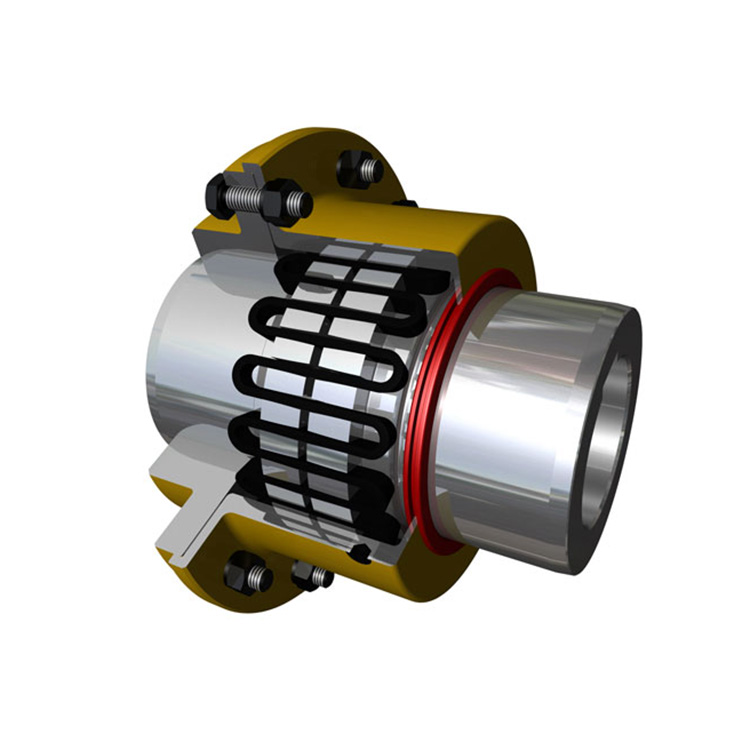
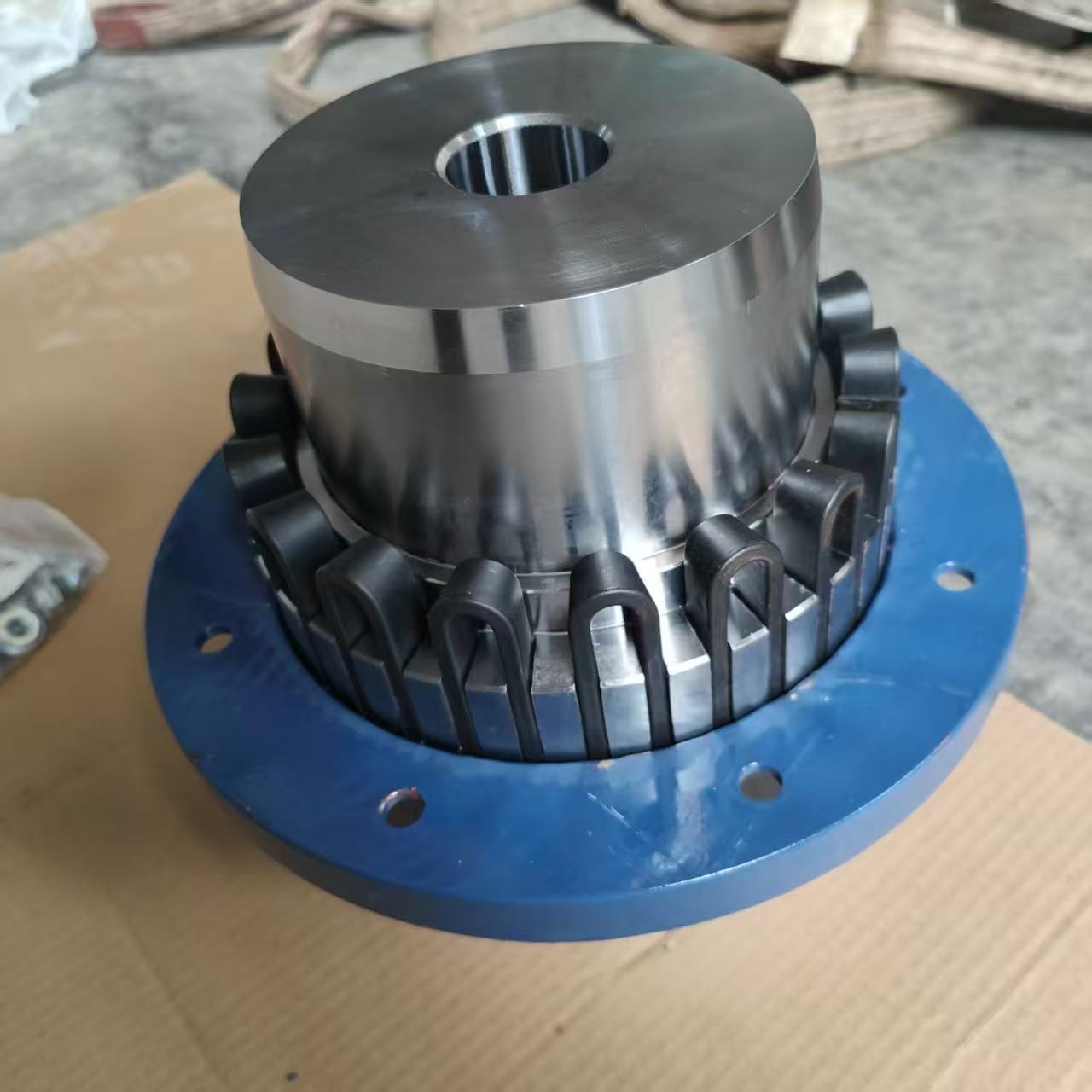
The heat treatment applied to the grid steel is as important as the grade itself. Quench-and-temper heat treatment produces a fine-grained microstructure with a surface hardness in the range of 42 to 50 HRC — hard enough to resist surface wear in the slot contact, tough enough at the core to resist the shock loading that would fracture a through-hardened part. A spring grid coupling with an inadequately heat-treated grid shows surface galling within the first hours of operation and fatigue cracking within the first service interval — problems that a proper heat treatment cycle would have prevented at the manufacturing stage.
Hub and Sleeve Materials: Balancing Strength and Machinability
The coupling hubs and sleeve are load-bearing structures, not spring elements. Their requirements are high yield strength for torque transmission, good machinability for the bore and keyway, and adequate toughness for the installation stresses of shrink-fit or press-fit assembly. The material of choice for most spring grid coupling hubs and sleeves is a medium-carbon steel in the 0.35% to 0.45% carbon range — the same family as the grid, but without the aggressive quench needed for surface hardness.
Alloy substitutions — chromium-molybdenum or nickel-chromium grades — appear in hubs for larger sizes or higher-speed applications where the combination of strength and toughness justifies the cost. Cast iron appears in some economy hub designs for low-speed, low-torque applications where the lower modulus of cast iron reduces the torque transmitted per unit of angular deflection, and where the lower cost fits the application. For heavy industrial service, steel hubs are the standard; cast iron hubs should be verified against the actual torque and speed conditions rather than assumed to be adequate on the basis of catalog availability.
Seal Compounds: The Unsung Variable in Coupling Life
The seal in a spring grid coupling is a nitrile rubber or fluoroelastomer lip seal that retains grease and excludes water, dust, and process contamination. Its material compounds determine the temperature range, chemical compatibility, and service life of the sealing function, and this is one of the areas where cost reduction most reliably degrades coupling performance in the field.
Standard nitrile rubber seals operate reliably in the range of minus 40 to plus 100 degrees Celsius in petroleum-based grease environments. Above this range — in furnace drives, kiln conveyors, or hot gas blowers — a fluoroelastomer (FKM) seal is required. FKM seals resist temperatures up to approximately 200 degrees Celsius but carry a significant cost premium and are not necessary for standard applications. Specifying the correct seal compound is a thermal and chemical compatibility check that belongs in the coupling specification, not a decision made at the manufacturing stage by default. A spring grid coupling equipped with nitrile seals in a hot environment fails on the seals before the grid reaches its design life — an avoidable failure that costs a seal replacement and a service interval lost to the contamination event that the seal should have prevented.
Grease Selection and Compatibility
The grease inside a spring grid coupling serves three functions: lubricating the sliding contact between the grid and the hub slots, lubricating the sliding contact between the grid and the sleeve, and protecting all internal surfaces from corrosion. The grease must maintain these properties at the coupling's operating temperature range, resist the contamination ingress that a marginal seal allows, and remain stable under the mechanical working that the grid imposes on it during each deflection cycle.
EP-grade (extreme pressure) greases with a lithium-complex or polyurea thickener are the standard for spring grid coupling applications. The EP additive package provides load-carrying capacity at the metal-to-metal contacts in the grid slots; the thickener system provides mechanical stability under the working cycle. For food-industry applications, a non-EP grease with NSF H1 registration is specified to meet food safety requirements. For high-temperature applications, a synthetic-based grease with a fluorinated thickener may be required. Matching the grease specification to the operating conditions — not accepting the supplier's standard fill as universal — is part of specifying a spring grid coupling correctly for a given application.
Surface Treatments and Corrosion Protection
The internal surfaces of a spring grid coupling are protected by the grease film under normal operating conditions. The external surfaces — the exposed hubs, the cover flanges, the hardware — face atmospheric corrosion in any humid or mildly corrosive environment, and process contamination in harsh applications. Standard finish for external surfaces is a shop primer or phosphate treatment, adequate for indoor storage and standard service. For outdoor, marine, or mildly corrosive process environments, the external surfaces should be specified with a higher level of corrosion protection: zinc electroplating, Dacromet coating, or a two-part epoxy primer and topcoat system.
Seal compatibility with the external coating is a detail that is frequently overlooked: zinc-plated surfaces can accelerate nitrile seal aging in the presence of water, and some coating solvents attack rubber seal compounds during the curing process. A complete coating specification for a spring grid coupling should include both the external corrosion protection and a note that seal materials have been verified compatible with the coating system.
Material Traceability and Certification
A spring grid coupling specification that names only a material grade — "hub: AISI 1045 steel" — without requiring traceability to a material test report is incomplete. The material test report documents the actual heat number, the actual chemical composition within the permitted range, and the actual mechanical properties — yield strength, tensile strength, elongation — as-machined from the specific heat of steel used. A coupling that arrives without material certificates cannot be verified as the material specified, and a buyer who accepts delivery without the certificates has accepted the risk of a material mismatch in service.
For critical applications — nuclear, aerospace, or high-pressure oil and gas — material traceability to the source mill heat is contractually required, with the coupling supplier responsible for maintaining the chain of custody from the steel mill through each machining operation. For standard industrial applications, the minimum expectation is a material certificate from the coupling manufacturer confirming that the materials used meet the specification, with the right to request the underlying mill test reports if the application warrants the verification.
How Material Choices Affect Total Cost of Ownership
The material decisions in a spring grid coupling — steel grade, heat treatment, seal compound, grease specification, surface protection — account for a relatively small fraction of the purchase price but determine the vast majority of the total ownership cost. A coupling with an inadequately hardened grid and basic nitrile seals in a hot application fails in a fraction of its design life, forces an unplanned outage, and requires replacement of the grid and the seals — a cost that, multiplied over a few failure cycles, exceeds the price premium for a correctly specified unit from the beginning.
The specification discipline that protects ownership cost is specifying the materials to match the actual operating conditions, not accepting the supplier's standard configuration as adequate. For a standard indoor conveyor in a clean, moderate-temperature environment, the standard configuration is correct. For the same coupling running near a furnace, in salt air, or in a food-processing washdown, the standard configuration is the wrong buy. A spring grid coupling specification that names the duty conditions — temperature, contamination, chemical exposure, speed — lets the supplier apply the material system that matches the application rather than the cheapest system that clears the basic catalog check.
Frequently Asked Questions
What steel grade is used for the grid element in a spring grid coupling?
Medium-carbon or low-alloy steel in the 0.35% to 0.55% carbon range, with controlled manganese and chromium for hardenability. The specific grade varies by manufacturer and size, but the critical requirement is the heat treatment — a quench-and-temper cycle that produces a surface hardness of 42 to 50 HRC while maintaining core toughness. A grid that is through-hardened to maximum hardness is brittle under shock; adequate surface hardness with core toughness is the correct target.
How does seal material affect spring grid coupling performance?
The seal compound determines the temperature range and chemical compatibility of the sealing function. Standard nitrile rubber serves from approximately minus 40 to plus 100 degrees Celsius. Fluoroelastomer seals extend the upper limit to about 200 degrees Celsius. Specifying the wrong seal compound for the operating temperature causes the seal to harden, crack, or swell — losing its sealing function and admitting contamination to the grid and grease well before the coupling's design life ends.
Why does heat treatment of the grid matter more than the steel grade?
The steel grade provides the chemical composition; the heat treatment provides the microstructure. A perfectly chosen steel grade with improper heat treatment produces a grid that is either too soft (insufficient hardness, rapid wear in the slots) or too brittle (excessive hardness, fracture under shock loading). The combination of the correct grade with the correct quench-and-temper cycle is what produces a grid that survives millions of deflection cycles without fatigue cracking.
Should I request material certificates for a standard industrial coupling order?
Yes, as a minimum. A material certificate from the coupling manufacturer confirming that the hub and grid materials meet the specification is standard purchasing language for most industrial buyers. For critical applications, the right to request the underlying mill test reports — documenting heat number, chemical composition, and mechanical properties — should be included in the purchase order, and the cost of those reports factored into the total procurement cost.
Conclusion
The spring grid coupling is an assembly of material systems, each chosen for a specific mechanical and chemical function in the coupling's operating environment. The grid steel and its heat treatment determine fatigue life under cyclic loading. The hub material balances torque capacity with machinability. The seal compound sets the thermal and chemical limits of the sealed environment. The grease maintains lubrication and corrosion protection. The external surface treatment determines how the coupling survives its atmospheric or process environment. Each of these material decisions is a variable in the ownership cost, and the plant that specifies its duty conditions completely — temperature, contamination, speed, chemical exposure — gets a spring grid coupling whose materials match its application, whose design life is achievable, and whose maintenance burden stays within the budget that the original purchase price implied.
References
ASM International (1991). ASM Handbook, Volume 4: Heat Treating. ASM International.
ASM International (1990). ASM Handbook, Volume 1: Properties and Selection: Irons, Steels, and High-Performance Alloys. ASM International.
Bhadeshia, H.K.D.H. & Honeycombe, R.W.K. (2017). Steels: Microstructure and Properties, 4th Edition. Butterworth-Heinemann.
Callister, W.D. & Rethwisch, D.G. (2018). Materials Science and Engineering: An Introduction, 10th Edition. Wiley.
AGMA 9002-B04 — Flexible Couplings: Design Considerations and Selection